
Google E-E-A-T Explained: What It Is & How It Affects SEO in 2026
As AI has made it easier to produce content, demonstrating a people-first experience, expertise, authority, and trust has become essential. What needs to be understood is that when people search for health, money, and safety content, search engines cannot afford to provide content that is not credible, comes from one’s own experience, or is AI-generated with no human intervention.
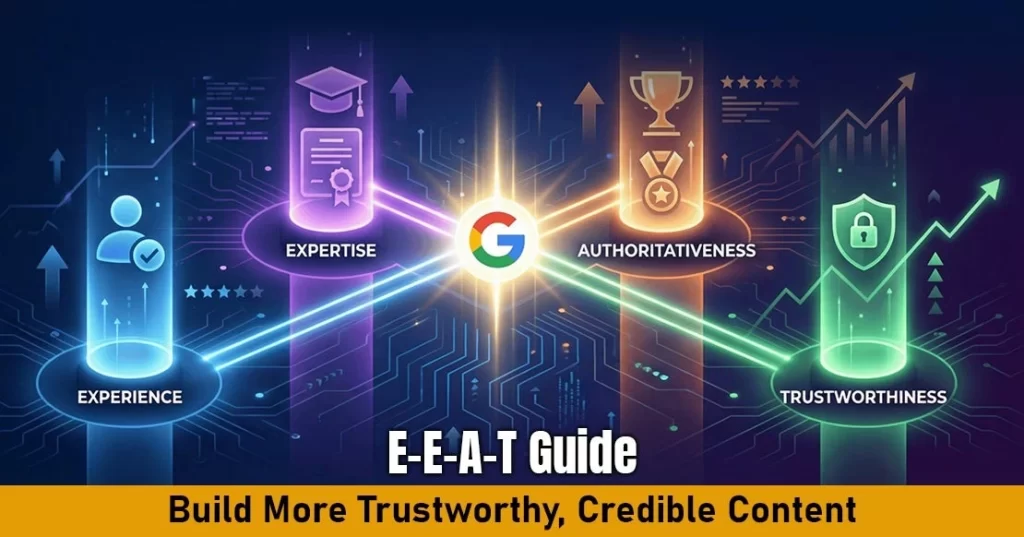
This is where Google E-E-A-T comes in. E-E-A-T is a framework that provides guidance to writers and Google that content must contain experience, expertise, authoritativeness, and trustworthiness. A valuable, trustworthy piece of content that is in line with the latest EEAT guidelines helps Google identify reliable sources and push it to the top, helping your content to rank on SEO and other search results.
Whether you’re a business owner, blogger, or content strategist, writing E-E-A-T-oriented content is a path to long-term credibility, visibility, and growth. SEO will evolve over time, but trust is the most important aspect of Google E-E-A-T.
What is Google E-E-A-T? Breaking Down Each Letter
Google uses real people called quality raters to check if search results are actually useful. To determine whether a piece of content is useful, they use a framework within Google’s Search Quality Rater Guidelines called E-E-A-T, which stands for Experience, Expertise, Authoritativeness, and Trustworthiness.
E-E-A-T’s experience signifies the people-first experience with product, place, or what they are referring to. An AI model is more than capable of writing on pretty much every topic you throw at it. This is why your own experience, sources, and how you bind it all together at the end matter a lot more than how you place the keywords and the sheer density of them.
Similarly, expertise means not writing somebody else’s found information or case studies; instead, search, understand, and write in a way that demonstrates your own knowledge and skills. Authoritativeness emphasises content or author credibility; the content should have relevant backlinks and a genuine author profile. Trust focuses on emerging as a credible source users can rely on, with up-to-date information and accurate facts. Let’s break down each letter for better understanding.
1. E- Experience
E stands for Experience and refers to the content showcasing first-hand experience, such as actual product use, visiting a place, or communicating what someone experienced. Google itself explained in (Google Search Central 2022) that if you want to know how to file your taxes correctly, you probably need an accounting expert’s advice. But if you’re searching for a review of tax software, you might believe a real experienced user forum’s post rather than a marketing piece.
2. E – Expertise
The second E stands for Expertise, which is the extent of knowledge and skills represented by the content and the writer. How much of an expert are they? So, you need to create quality content that contains credible insights or real data. Just like Backlinko did, they didn’t just claim backlinks help you rank higher on Google. Instead, they checked around 11.8 million search results themselves and counted the backlinks. What they found was that specific pages ranked #1 have almost 4 times more backlinks than pages ranked #2 through #10. Moreover, we did it internally to check the credibility of this data. We found that quality and relevant backlinks are what Google likes seeing.
3. A – Authoritativeness
A stands for Authoritativeness, refers to your reputation as a reliable source on any subject matter. It is evaluated by checking the source’s backlink profile. The better the quantity, quality, and relevance of backlinks, the more authoritative your site and author are. As a personal example, we saw a little dip in one of our websites’ traffic, then we went to the bottom of it and found out that most of our bios were outdated. So, as the first order of business, we changed them and updated them to the latest writers’ details, and Voila, we started getting traffic again. Another important part is how your content is quoted and referenced by other websites.
4. T – Trustworthiness
T stands for trustworthiness, which means providing confidence to your visitors in your content and website. Is the content transparent and safe to rely on? Make sure your content and website have secure HTTPS, all information is up to date, and reviews are accurate. Moreover, ensure there are no vague sentences that aren’t backed by hard facts.
E-E-A-T vs E-A-T: What Changed & Why?
Every year Google updates its algorithm to make it better for its users. A major update came back in December 2022, when Google added one more E, which means Experience, into its Quality Rater Guidelines to formally expand E-A-T.
The goal was not to devalue expertise a little; instead, it was to acknowledge that theory alone doesn’t satisfy user intent. Experience allows Google to surface content written by people who have first-hand experience or been through the process themselves. And we have seen it in real time. Our team wrote 10 identical pieces of content, each by a different writer and with a different approach. The pieces with the most experience ranked best.
How Does Google Evaluate E-E-A-T?
You might be wondering how Google actually measures E-E-A-T. As mentioned above, Google uses a team of people called the Quality Raters. However, this is not the full picture. Google also uses smart algorithms to evaluate content.
Google is never against AI, but it says to combine or enhance AI-written content with real human experience. The main thing is whether the finished content is original, accurate, useful and created for people rather than simply to manipulate search engines.
Google uses search quality raters who review search results using detailed guidelines. They consider real-world experience, expert knowledge, website authority, and trust markers like secure browsing and clear contact details.
On the other hand, algorithms focus on the difficult part. Google looks for measurable indicators such as backlinks from respected sources, author bios and credentials, real user reviews or case studies, and technical trust elements like HTTPS and privacy policies. Together, they give Google a complete picture of how credible your content is.
Why Does E-E-A-T Matter for SEO and Content in 2026?
E-E-A-T matters for more than just showing up in useful search. It helps your content actually perform well on Google. E-E-A-T can make or break your business, because it acts as a quality signal that shapes how Google sees your site even if not directly. Moreover, readers themselves prioritise content that has the above-mentioned elements in it.
Many users use AI tools to quickly write content, but content written using these tools, without any human intervention, sometimes fails to rank well on SEO. Not only that, but AI generative models like ChatGPT, Claude, and others can also struggle to show your content in search results. But E-E-A-T helps AI generative models to fetch your content as a reliable source for whatever the user is searching for. And how do you make your content better? By using credible sources, linking them, showing experience and writing 100% credible and accurate information.
Here’s a simple way to think about it: content written by someone with real experience and real knowledge just feels more genuine, and people easily trust that. Think of it. If we were to simply write about EEAT without telling you our own experience, would you believe us? Maybe you’ll discard us as another generic content website with nothing original.
A strong E-E-A-T approach doesn’t just help you rank higher; it also makes your site better aligned with Google’s long-term emphasis on helpful, reliable content.
How to Improve E-E-A-T for Your Content?
Establishing a strong E-E-A-T is no longer difficult; just focus on transparency, authenticity, and quality that will help your content rise above the noise and resonate with both users and search engines. As there is no specific set of instructions, we’ll share what worked best for us across hundreds, if not thousands, of pieces of content.
Follow the practical tips to boost E-E-A-T and build long-term digital authority.
- Always publish helpful, well-written content that shows you’re active, reliable, and committed to your niche for both your audience and Google.
- When you link to important claims with relevant, primary or highly credible source websites in your content, readers and search engines are more likely to trust your content.
- Make sure you engage and share with followers on social media to build an online presence that shows there’s a real person behind the brand or content.
- Your About Us page is a source of trust and credibility for a reliable source. It should clearly explain who you are, what you do, and why people should believe in your expertise.
E-E-A-T Checklist for Your Content and Website
Use this E-E-A-T Checklist that provides a clear path for every blog post and website improvement.
- Always use case studies and testimonials, and original research to support claims in your write-ups.
- Make sure to include credentials, experience, and links to professional profiles to build credibility.
- Secure your site by implementing HTTPS and display clear contact information and policies to present it as a safe option to rely on.
- Keep your old posts up to date or remove ones that no longer provide value, as outdated information can cost you big time.
- Use structured data by implementing schema markup to highlight authors, organisations, and reviews.
The Real Goal of E-E-A-T is Building Trust
There’s no shortage of content online today. What makes a writer stand out is sounding genuine and feeling authentic so people actually believe what they read.
This is where E-E-A-T comes in. It helps writers meet Google’s quality standards. By prioritising all four parts of E-E-A-T, including Experience, Expertise, Authoritativeness, and Trustworthiness, you can create content that people want to read, share, and come back to.
AI has made it easier to publish content. It hasn’t made it easier to earn trust. That’s the real value of E-E-A-T. The strongest content doesn’t simply tell Google that it is credible. It gives readers enough evidence to believe it themselves.
Recent Posts




Categories
Social Media Share
Facebook
Twitter
LinkedIn
WhatsApp
Pinterest
Telegram
Reddit

Abhishek Pal
Abhishek Pal has spent 5 years working across public relations and marketing, and he writes to help brands understand what actually builds visibility that converts. Her work at SDAD Technology covers media positioning, brand storytelling and the marketing systems that turn attention into trust, drawing on experience helping businesses move beyond scattered campaigns toward strategies that compound over time. He has a strong grasp of how earned media, content and performance marketing need to work together rather than sit in separate silos, and his writing reflects the patterns he has seen play out across client work. Abhishek advice is built around one idea, that visibility only matters when it earns credibility.